
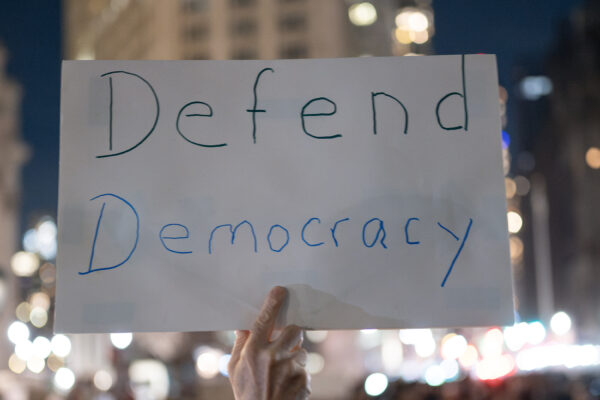
One year ago, President Donald Trump was sworn in for a second term. Within hours of his inauguration, it was clear that he and his administration would, once again, test the Constitution and the willingness of our nation’s institutions and people to defend it. However, what stood out most to us during the last year has been the volume, pace, and persistence of the second Trump administration’s assault on many of our most fundamental rights and freedoms. There were multiple flashpoints throughout the last year, as the administration’s “shock and awe” strategy yielded a sustained and aggressive assault on civil rights and civil liberties resulting in 225 executive orders signed (as of December).
Near daily efforts to dismantle civil rights and civil liberties protections, intimidate marginalized communities, and upend the rule of law threatened to normalize the previously unthinkable. At the U.S. Supreme Court, blows to trans rights and free speech set dangerous precedents. At the state level, attacks on core protections for reproductive freedom and voting rights persisted.
Although we faced an incredibly bleak landscape for civil rights and civil liberties, the ACLU did not relent because we were ready on day one and able to meet the Trump administration’s shock and awe strategy with an even more shocking and awesome response. Months before the 2024 election, we studied President Trump’s campaign promises and Project 2025, and, in a series of public memos, laid out the civil rights and civil liberties threats a second Trump presidency would pose. We anticipated the renewed attacks on immigrants and other vulnerable communities, expanded domestic use of federal force, and systematic efforts to suppress dissent.
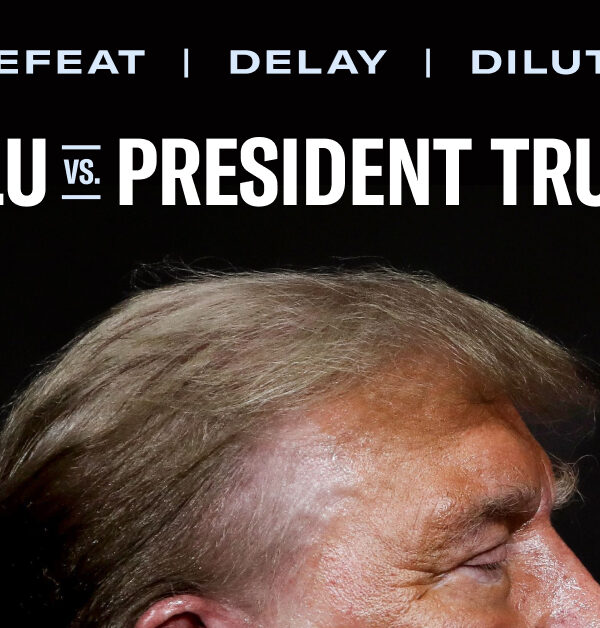
Yet, defending the Constitution in this environment has required more than advance preparation and a sense of urgency. It necessitated an unshakable belief that democratic norms are worth fighting for even when the pressure seems unyielding. That’s why we mobilized our lawyers, advocates, organizers, storytellers, and supporters to delay unconstitutional policies before they took effect, dilute their reach when full blockage wasn’t immediately possible, and defeat them through courts, public pressure, and sustained organizing.
One year in, our work is guided by a simple principle: we are only in a constitutional crisis if we allow ourselves to be.
We Fought — and Won — in Court
Mere hours after taking office, President Trump issued a blitz of executive orders and policy directives that immediately threatened birthright citizenship, trans rights, freedom of speech, and voting rights. Our response reflected a core constitutional principle: rights endure not because leaders respect them, but because people and institutions insist on enforcing them.
- Birthright Citizenship. Two hours after President Trump issued an executive order attempting to end birthright citizenship — a constitutional guarantee for more than 150 years — the ACLU sued. When a Supreme Court ruling threatened partial enforcement of the order, we shifted tactics, filing a class-action lawsuit that protected more than 129,000 children from harm. This spring, the ACLU’s National Legal Director, Cecillia Wang, will argue the case before the Court that the administration’s attempt to end birthright citizenship violates the 14th Amendment.
- Alien Enemies Act. We also sued the Trump administration over the president’s unlawful and unprecedented invocation of a centuries-old wartime act, the Alien Enemies Act, to accelerate mass deportations. This spring, the ACLU scored a critical legal victory with the U.S. Supreme Court ruling that individuals must be given due process to challenge their removal under the Alien Enemies Act. Additionally, in December, a federal judge ruled that the Venezuelan men sent to the CECOT prison in El Salvador were denied due process and ordered the government to facilitate their return or offer hearings compliant with due process.
- Free Speech. The ACLU acted swiftly to secure the release of international students and scholars Mahmoud Khalil, Rümeysa Öztürk, Mohsen Mahdawi, and Dr. Badar Khan Suri who were detained by the Trump administration for their pro-Palestinian speech. Claiming their speech threatened U.S. foreign policy, the government sought to intimidate dissent by using immigration enforcement to punish lawful political expression. In addition to securing the students’ release, the ACLU was able to protect them from immediate deportation while their cases move through the courts, reaffirming that political advocacy is not grounds for exile.
- Troop Deployment. We took action when federal troops and National Guard units were sent to cities including Los Angeles, Chicago, and Washington, D.C., under the pretext of controlling protests. Through lawsuits, friend-of-the-court briefs, and aggressive transparency demands, we forced scrutiny of these actions and constrained their scope so that this grave abuse of power will never be normalized. Thanks to a string of court victories prohibiting deployments, including in Illinois v. Trump, as well as sustained political opposition, President Trump announced on New Year’s Eve that he was abandoning efforts to use the National Guard in Los Angeles, Chicago, and Portland.
- Equal Protection. When President Trump signed an executive order directing federal agencies to withhold funds from medical providers and institutions that provide gender-affirming medical treatments to anyone under 19 years old, we challenged the order. A court then temporarily blocked the Trump administration from enforcing it.
The ACLU's legal docket comprises 239 legal actions and 139 lawsuits. More importantly, a majority (64 percent) of our cases succeeded in delaying, diluting, or defeating the Trump administration's policies. As a result of our’s and other organizations’ efforts, the courts continue to be a check on the power of the presidency, just as our Constitution demanded.
We Mobilized Communities and Built Power
As proud as we are of our work in the courts, we know that we will not be successful unless millions of individuals demand change. Across the country, ACLU affiliates and partners trained more than 84,000 people on their rights and enrolled 180,000 individuals in our People Power activist program. When protests were met with militarized responses, we rapidly expanded Know Your Rights training nationwide, equipping tens of thousands of people to demonstrate safely and lawfully. We also mobilized our supporters and members of Congress to advocate on behalf of immigrants facing neglect and abuse in detention centers.
In what became one of the most visible free-speech confrontations in recent decades, political pressure led ABC to suspend Jimmy Kimmel Live! after FCC leadership threatened broadcast licenses over a monologue they found objectionable. The ACLU mobilized more than 500 prominent artists and more than 50,000 supporters to sign an open letter criticizing Trump administration’s attempts at censorship. Within hours of our mobilization, the show returned to air — stopping the censorship before it could harden into precedent.
The Road Ahead: 2026 and Beyond
As we enter 2026, the stakes feel as high as ever. In coming months, the courts will make decisions that affect civil rights and civil liberties and determine whether marginalized communities can fully participate in public life for years to come. This year also marks the 250th anniversary of the Declaration of Independence — a moment that reminds us of the centrality of liberty and equality to the founding of our nation.
Having led the ACLU through eight presidential administrations, I’ve learned one thing for certain: progress is never permanent, and setbacks are never inevitable. Yet, our work endures. What the ACLU does over the next three years and how well we do it will play a role in shaping the course of American history.
This is because democracy doesn’t defend itself — people do. And together, we will keep showing up.