Book bans are nothing new, especially those that target books centered on the experiences of the most marginalized communities.
Yet in recent years, we have seen challenges to books in classrooms and libraries accelerate and mutate due to advancing technology and politicized efforts to restrict freedom of expression.
Book bans infringe on the right of schools and teachers to make certain books – predominantly those by Black, brown, and LGBTQ+ authors discussing issues of race, gender, and sexual orientation – available to students to learn from and explore. By targeting specific experiences, typically those of marginalized communities, book bans undermine power and reinforce discrimination. They are unlawful and a serious threat to our freedom to learn.
This year, we have also witnessed artificial intelligence (AI) companies attempting to “destructively scan all the books in the world” to train their chatbots, utilizing a method called “hoard-and-destroy.” Book destruction privatizes public knowledge and hinders opportunities for original and creative thought.
Instead of banning and destroying books, we should promote them, especially those that challenge us to think critically and engage with diverse perspectives different from our own.
To honor this year’s Banned Books Week, we spoke with John Powell, a reference and instruction librarian at Rutgers University’s Paul Robeson Library, about the role libraries play as protectors of intellectual freedom, how challenges to accessing books continue to evolve, and what we can do to protect our right to read.
ACLU-NJ: How did you become involved in library work?
John Powell: I came to library work after losing what I thought was my dream job as an editor at a large dot com. Following the downsize, I was back to working in the nonprofit arts and retail sectors when a friend recommended I consider library school. I enrolled in a program that offered online courses and shortly after graduating, I then found my true dream job working as an academic librarian.
ACLU-NJ: Why is it important to think critically and engage with perspectives different from our own? How do libraries support this?
Powell: Engaging with different perspectives and thinking critically is important in helping us to challenge assumptions, understand other people’s experiences, recognize bias, and become better informed when it comes to making everyday decisions. Libraries support this by providing access to a wide variety of reliable resources that represent different viewpoints and ideas. And, not for nothing, librarians are very good at helping patrons identify misinformation and find credible sources.
ACLU-NJ: What kinds of books get banned? Are book bans allowed in New Jersey?
Powell: Books that get challenged or banned are usually those that feature LGBTQIA+ identities, race and racism, and sexual content or mature themes. New Jersey school boards have banned books in the past; however, the state passed the Freedom to Read Act in 2024 to help protect New Jerseyans’ access to library materials. Which is not to say this legislation can permanently end challenges or bans, but there are now guardrails in place to help libraries push back on censorship attempts.
ACLU-NJ: Why exactly are book bans so dangerous and undemocratic?
Powell: I think they are dangerous and undemocratic because they are an obvious attempt to limit access to information. Having books pulled from the shelves of our libraries over content disagreements prevents our community members from learning about different cultures, viewpoints, and historical experiences which is an assault on intellectual freedom. Book bans are also disruptive to education by eliminating resources that teachers might use to discuss challenging subjects with their students.
ACLU-NJ: What can librarians do when book bans are proposed or implemented? What can the public do?
Powell: When bans are proposed or implemented, librarians should follow viewpoint-neutral collection policies so that their decisions about the books are based on agreed upon criteria and not just political pressure. Librarians should also document the challenges, report them to the American Library Association’s Office for Intellectual Freedom, and make the process transparent to their patrons. Members of the public can attend library boards or public meetings to participate in the applicable public comment process. They can also respectfully share their views with their elected officials and library administrators.
As technology evolves, we’ve witnessed challenges to books evolve as well. In recent months, the AI company Anthropic has been accused of attempting to destroy and scan books to train their chatbot, Claude. Amazon is also being investigated for similar practices. What does the mass destruction of books to train AI bots mean for access to books and critical thinking?
Powell: The mass destruction of books to train AI bots impacts access by essentially privatizing formerly public knowledge. Once the book has been destructively scanned, the physical copy no longer exists, thus creating a barrier for students and researchers. The digitized text becomes corporate property, and instead of letting us read the scanned text, the AI company now only lets us access the information by interacting with their bots. These AI learning models can merge millions of distinct perspectives into a homogenized, corporate-approved output which suppresses intellectual friction and kneecaps critical thinking. By taking away our ability to read the book, the AI companies are denying us the ability to evaluate the text and form our own independent conclusions. As more books are scanned and destroyed, the AI models become the gatekeepers of information, and we are now reliant on the synopses of their bots.
ACLU-NJ: If there was one message you’d like our readers to take away from this interview, what would it be?
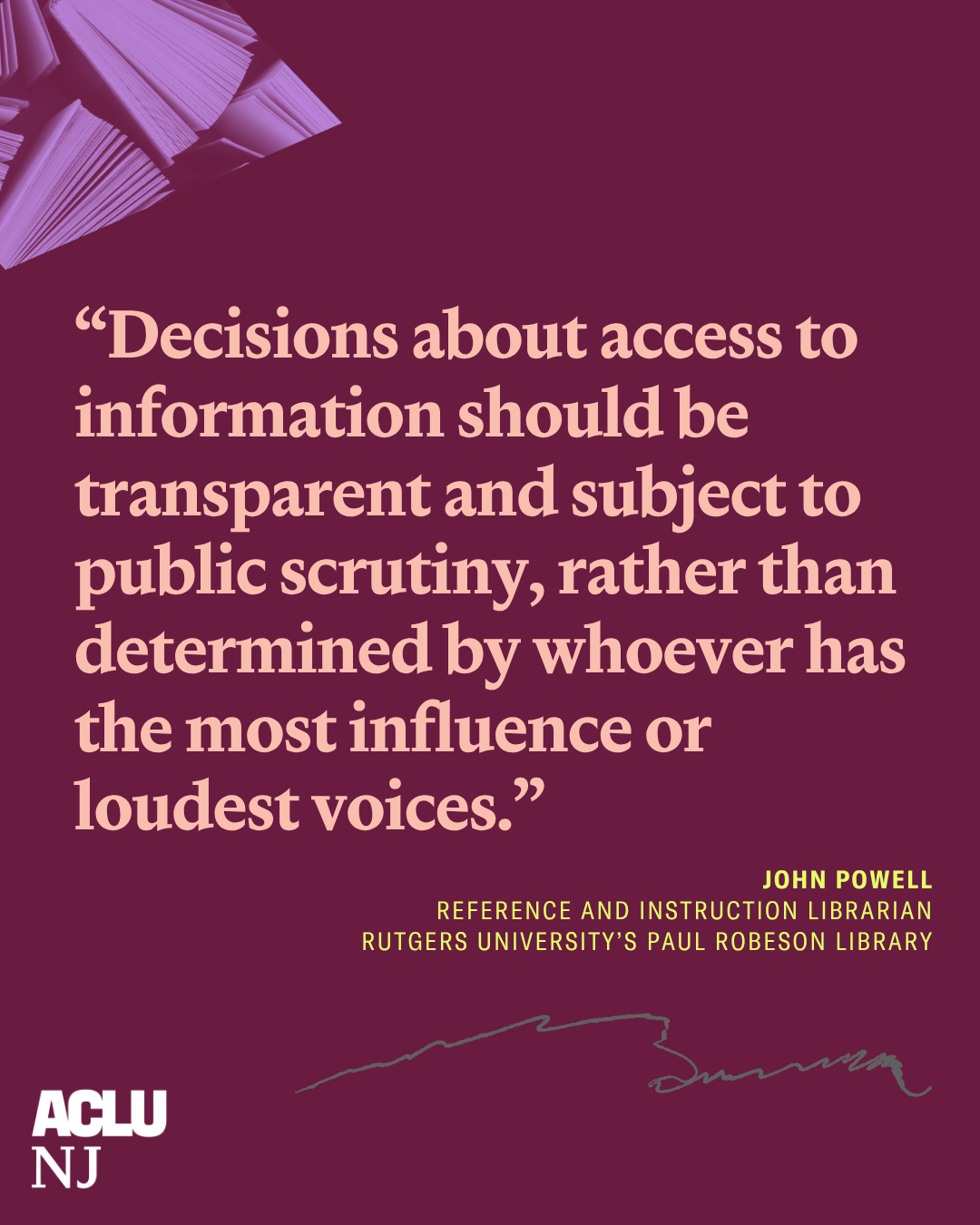
Powell: Decisions about access to information should be transparent and subject to public scrutiny, rather than determined by whoever has the most influence or loudest voices.
ACLU-NJ: On a more personal note, what are you reading right now?
Powell: I am currently reading Rebel Girl: My Life as a Feminist Punk by Kathleen Hanna.