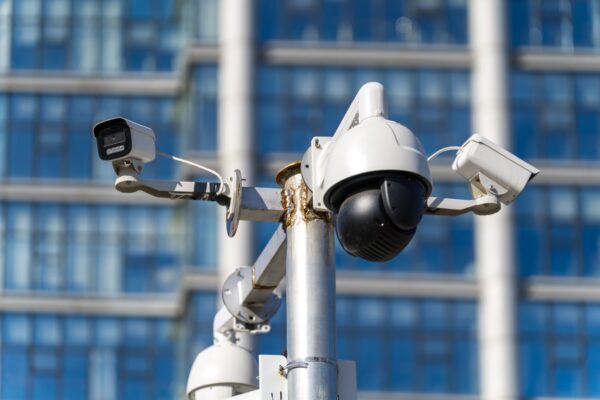
Everyone has the right to live their lives without being constantly surveilled – yet automatic license plate reader (ALPR) cameras track us every day wherever we drive.
ALPR cameras, from companies like Flock Safety, capture photos of passing vehicles and log them into massive databases. These databases are searchable by government agencies across the entire country, with little to no transparency, oversight, or accountability for how our data is collected, stored, or misused. This is a privacy nightmare at a time when it has never been easier for artificial intelligence (AI) to scrutinize every move we make.
Massive networks of ALPR cameras have no place in a society that values privacy and safety. To actually protect the privacy and safety of our communities, New Jersey must ban these creepy cameras now.
We answered some of your questions about ALPRs, how they’re being used in New Jersey, and what New Jersey can do to protect our rights to privacy and safety.
What are ALPRs?
Automated license plate reader (ALPR) cameras are mobile and stationary cameras that record and digitize images of license plates of cars that pass into their view, capturing the time and place each car was seen in a database.
Although ALPRs have been around for some time, they have recently grown more powerful and widespread. The number of ALPR cameras has exploded over the past five years, and now AI allows cameras to record not only license plates, but car make, model, and other identifying features like dents or bumper stickers.
The prevalent use of this technology results in an expansive network that monitors the movements of every New Jerseyan without exception, allowing individuals to be tracked through their day and revealing the private details of their lives.
Where does the data collected by ALPRs go?
States and municipalities that use ALPRs have not developed this technology on their own. Instead, they contract with third-party private vendors – like Flock, Axon, and Motorola Solutions – who control the platforms where location tracking data is stored.
In some cases, these companies own the camera infrastructure itself and have refused to uninstall cameras even when a town requests the cameras’ removal. For example, Flock has been known to deny requests to remove ALPR cameras.
These third-party vendors serve as centralized hubs for the data. The vendors make the data available for use not only by the municipality that has paid for the cameras, but with a national ALPR data-sharing network. Practically any jurisdiction with a contract can access the data on your movements without a warrant.
Do ALPRs make us safer?
Proponents of ALPR technology often cite public safety benefits, but these claims are not supported by evidence. An analysis of FBI data from Atlanta shows that despite increasing the number of cameras in the city by eight times – to a total of more than 28,000 integrated cameras within their police surveillance system – Atlanta has not seen a meaningful increase in crime clearance rates.
And like all technologies, ALPRs can create new threats to our safety. For example, ALPRs can misread license plates – a study of Flock cameras found that 1-in-10 license plates scanned by Flock’s AI-powered cameras misread the state that the license plate came from. When a system gets a license plate wrong or flags a vehicle for a mistaken reason (e.g. the system marks the wrong car as stolen), it can lead to dangerous traffic stops that do nothing to make our roads safer. There have been numerous instances documented where cars have been unnecessarily pulled over because of ALPR error or misuse.
How are ALPRs harmful?
At their core, ALPRs are a tool for mass surveillance. When they are installed in your neighborhood and on every road you drive down, the cameras form a picture of your life including when you go to work, where you worship, when you take your child to school or soccer practice, or where you go to the doctor. The intimate details of your life are amassed and left vulnerable to the many jurisdictions – and their officers – that can now access your data without a warrant.
Our privacy is protected by the Constitution for good reason – giving the entire government the power to invade our privacy with little justification leads to abuse and tyranny that affects everyone. There are countless examples that illustrate how ALPR data has been weaponized against our communities, especially communities that already face marginalization.
Immigrant Communities
Immigration and Customs Enforcement (ICE) uses data from ALPRs to supercharge their immigration enforcement in communities across the country. Even when ICE does not have a contract with an ALPR vendor, they have been able to access this data through local police departments that look up information, either through a formal request or as a “favor” to ICE.
People Seeking Reproductive or Gender-Affirming Health Care
Jurisdictions that criminalize people who have sought abortions and/or gender-affirming health care have used ALPRs to track individuals who have left their state to seek reproductive health care. In one example from Texas, a sheriff conducted a nationwide ALPR search with the query “had an abortion, search for female.”
People Exercising Their Right to Protest
Analysis of ten months of nationwide searches of Flock data revealed that more than fifty agencies ran searches in connection with protest activity, including specifically searching for activity related to lawful activism. The use of ALPR cameras, and other mass surveillance technology, can serve as a deterrent for those who would otherwise engage in protest or other protected First Amendment activity.
Abusing Data Access to Stalk People
Law enforcement departments using ALPRs often allow a wide range of their staff to access the data. Unfortunately, there have been dozens of instances of employees who abused this access to stalk current or former romantic partners. For example, a Georgia police chief tracked his ex-girlfriend and her daughter approximately 600 times.
Are ALPRs being used in New Jersey?
Yes, ALPR use is widespread in New Jersey. Per the Office of the Attorney General’s 2024 audit, 523 of the State’s 530 law enforcement agencies use them.
You can see where ALPR cameras are deployed in New Jersey on the crowd-sourced map created by DeFlock and contribute your own sightings here.
How are ALPRs regulated in New Jersey?
ALPRs and their use are subject to minimal regulation in New Jersey.
The most recent statewide policy from the Attorney General was issued in 2022. Among its provisions are audits and the lowering of the data retention period from five years to three years. But that policy does not create effective oversight or transparency. The audits only look at five percent of the ALPR searches conducted by agencies and do not report useful information that would give New Jerseyans confidence that their privacy is being protected. The three-year retention period of ALPR data also still makes New Jersey a national outlier.
Further policies have attempted to limit out-of-state data sharing, but the effectiveness of those policies is questionable. Under the Privacy Protection Act signed in 2026, New Jersey law enforcement agencies are able to share data with out-of-state agencies if that agency promises not to use the data for immigration purposes. If that agency breaks its promise, New Jersey’s Office of the Attorney General can, but is not required to stop data sharing with that agency. Other provisions still leave the door open to the virtually unaccountable use of New Jerseyans’ ALPR data by out-of-state agencies.
How do other states regulate ALPRs?
Many other states have passed a series of reforms aimed at banning or comprehensively limiting the use of ALPRs:
- Vermont’s ban on ALPRs goes into effect in July 2027. As of November 2026, Vermont is the only state to implement an effective ban against ALPRs statewide.
- In New Hampshire, ALPR data is retained for only three minutes.
- Other states have shifted to retention periods for only thirty or sixty days. Flock Safety itself sets a data retention default of only seven days, because research shows that 90% of ALPR searches are made within a week of an incident under investigation.
- Some states have passed strong rules limiting the sharing of ALPR data with government agencies. Since 2016, California has banned all sharing of ALPR data with federal and out-of-state law agencies.
How should New Jersey regulate ALPRs?
In the last year, communities across the country – including here in New Jersey – have come out in opposition to ALPR cameras and demanded that their elected representatives pass policies that better protect their privacy and safety.
The ACLU of New Jersey supports banning ALPRs to protect New Jerseyans’ privacy and safety. Tell your lawmakers to ban these creepy cameras now.