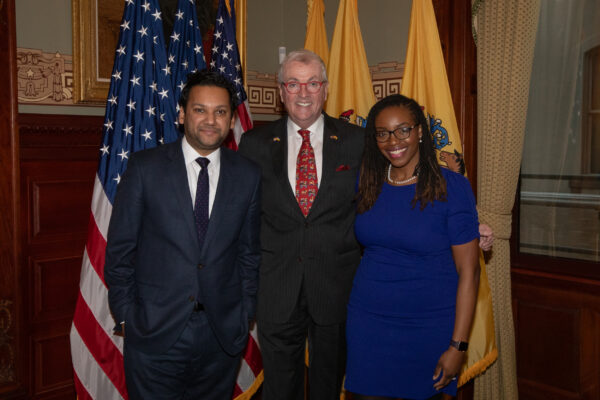
The United States must adopt a holistic approach to decarceration – and New Jersey has now seen the role governors can play in leveraging categorical clemency as a tool to remedy injustice.
The ACLU of New Jersey has dedicated decades to working toward reducing the state’s incarcerated population. Victories in the courtroom and in the Legislature have contributed to New Jersey’s historic reduction in its prison population by more than 50 percent since 2011. But to begin to repair the harms of mass incarceration, we need to use every tool available.
We launched The Clemency Project in 2024 as an integral part of a larger decarcerative vision that centers racial and social justice – and reimagines the criminal legal system as we know it. Under the Murphy administration, and with the support of philanthropic partners, we have been able to make historic strides for decarceration.
“For the past three years, I have had the privilege to connect with clients, hear their stories and help create an infrastructure where their dreams could come true,” said ACLU-NJ Director of The Clemency Project Rebecca Uwakwe. “I cannot thank Governor Murphy enough for his commitment and dedication to centering the voices of our clients by granting clemency at this historic level.”
Working alongside partners from Lowenstein Sandler LLP, New York University School of Law, Princeton University School of Public & International Affairs, and Rutgers University School of Law, The Clemency Project represented 90 people petitioning for commutations. Governor Murphy has granted 37 of our clients commutations, and 455 total people have received clemency, more than all New Jersey governors since 1994 combined.
“It is deeply rewarding to witness the first round of clemency releases in New Jersey,” said Public Defender Jennifer Sellitti. “Governor Murphy’s groundbreaking clemency initiative aims to right the wrongs of unjust and overly harsh sentences, while also acknowledging the powerful potential for human redemption. We look forward to working with our partners at ACLU-NJ to ensure that those we serve continue to receive consideration as part of this important work.”
“I am extremely proud of the contributions of The Princeton University Clemency Project and grateful for the 13 clemency grants the Governor approved,” said Princeton University SPIA in NJ Faculty Fellow Joe Krakora. “These grants are a tribute to the work of the 52 Princeton students who volunteered to assist me in filing petitions, and a broader achievement for decarceration efforts in New Jersey.”
“Working in partnership with ACLU-NJ’s Clemency Project in support of and alongside my client was one of the most special parts of my law school experience,” said Danielle Miles-Langaigne, a 3L at Princeton University School of Public & International Affairs. “I’m extremely grateful to have helped put together my client’s clemency application alongside my clinic partner and am beyond excited that Governor Murphy granted him clemency.”
Reviewing extreme sentences must be the expectation, not the exception. Adopting a comprehensive decarcerative vision is foundational for a fairer future, and releasing people from prison is fundamental to racial justice in New Jersey and beyond.
What is Categorical Clemency?
Categorical clemency allows a governor or president to examine holistic injustices that have impacted groups of people and consider relief for each person within the identified class.
It can come in the form of a pardon, which legally undoes a criminal conviction, or in the form of a commutation, which reduces or ends someone’s incarceration. The Clemency Project focused specifically on commutations.
Clemency is an important check and balance on the criminal legal system – and it is one that has existed since our nation’s founding as a tool to administer justice more fully.
“For centuries, clemency has changed lives for the better,” said ACLU-NJ Executive Director Amol Sinha. “We’ve seen the joy and hope that it brings families and communities. Through categorical clemency, New Jersey can fundamentally transform its criminal legal system and make it more just for everyone – and this is an opportunity we must continue to embrace.”
New Jersey has the nation’s highest racial disparities among its prison population, which makes categorical clemency an even more invaluable tool that is fundamental to racial justice and essential in repairing the harms of mass incarceration.
Clemency is not simply forgiveness. It is recognizing the dignity of those trapped in the criminal legal system, while acknowledging that change is necessary.
2022-2024: Conception to Launch
Inspired in part by the national ACLU’s Redemption Campaign, and supported by philanthropists including Jason Flom, the Vital Projects Fund, the Geraldine R. Dodge Foundation, and more, the ACLU-NJ's project works to specifically decarcerate New Jersey through categorical clemency.
“The timing was opportune for a project focused on clemency in New Jersey,” said ACLU-NJ Legal Director Jeanne LoCicero. “The Murphy administration had already shown interest in criminal legal reform and had been successful in reducing the prison population. We’re grateful for the administration’s partnership in making categorical clemency a reality.”
“Every New Jerseyan deserves the opportunity to thrive in the place they call home,” said Geraldine R. Dodge Foundation CEO Samra Haider. “Our core mission is focused on addressing the barriers that prevent communities of color from building wealth and achieving economic security in New Jersey. Our early investment in the ACLU-NJ’s Clemency Project was a key step in this commitment, helping to disrupt cycles of incarceration that limit opportunity. The positive impacts of The Clemency Project will influence the future of our state’s criminal legal system and realize a more just and equitable New Jersey for years to come.”
We had many discussions about potential categories to consider, and we focused on trial penalties and survivors of domestic violence. After brainstorming, the Department of Corrections provided support in our pilot program, smoothing the way for us to communicate directly with incarcerated people who might be eligible for legal support.
“The carceral system has devastated communities and deepened racial inequities across the country,” said Jason Flom, Co-Founder and CEO of Lava Media and Lava for Good Podcasts, and founding supporter of The Clemency Project. “By adopting a categorical approach to clemency, Governor Murphy has shown that New Jersey is committed to addressing systemic injustice, both past and present. I’m proud to see New Jersey do its part in prioritizing people over punishment.”
After over a year of developing the scope of the project, identifying partners, and collaborating with the Murphy administration, The Clemency Project was officially launched on February 22, 2024.
Post-Launch 2024: Gov. Murphy’s Executive Order and First Round of Releases
In June 2024, Governor Murphy signed an executive order that endorsed a categorical approach to clemency and created the Clemency Advisory Board, which was tasked with reviewing petitions for pardons and commutations, expediting the process for people who meet specified criteria for consideration.
“After the executive order became official, the Clemency Project reached out to every prison to connect with every incarcerated person who was eligible for clemency,” said ACLU-NJ Legal Fellow Brian Lozano. “We then created a separate intake process in which we reviewed and processed over 1,000 requests for representation. A lot of this work was done through teamwork of partners and the Office of the Public Defender, who retrieved records for us as we investigated.”
Once a client was retained, attorneys developed a petition for parole to send to the governor’s office. The petition included personal background information of each client, including childhood upbringing, details regarding the incident for which they were convicted of, institutional records, programs and classes they attended, re-entry plans, letters of support, and more.
In addition to filing petitions, we educated the public on what the clemency process looks like, including advocates, community members, and private attorneys. We held clemency workshops at Edna Mahan Correctional Facility for Women, East Jersey State Prison, and Returning Citizens, and provided continuing legal education for lawyers to help them file petitions on behalf of their clients.
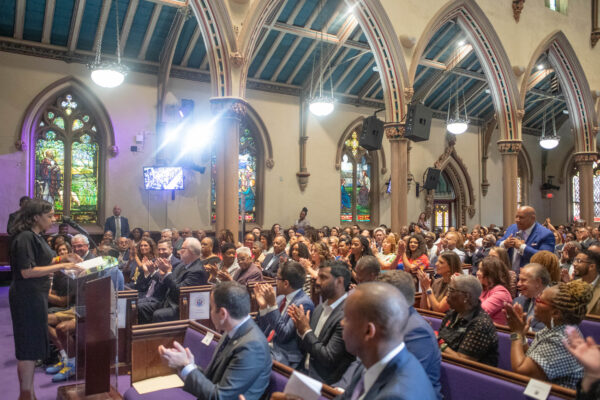
We also celebrated the first round of releases from state prison and three of our clients were granted clemency. This was monumental – the work our clients, team, and partners had put in had resulted in real, tangible changes to people’s lives.
The joy and relief we witnessed during this first round of releases was immeasurable and demonstrated the deep positive impact clemency has on people, their families, and their communities. This first use of Governor Murphy’s clemency powers set the tone for his next rounds of action and reinvigorated our team to keep working to build a fairer, more equitable future for all.
Our client, Dawn Jackson, was granted clemency in December 2024. Ms. Jackson, a survivor who faced abuse starting at the age of five, was sentenced to 30 years for fatally stabbing one of her abusers, without consideration of the abuse she had endured.
“I’m grateful for the chance to give back and instill empowerment into the lives of those who have been affected as I once was,” said Dawn Jackson. “I thank Governor Murphy for this opportunity to do more good and live freely as the resilient woman I have become.”
Ms. Jackson’s story is representative of so many others. When faced with a system that is overly punitive and dangerously deficient in assessing instances of trauma, survivors are often arrested for actions without context of their lived experience. Categorical clemency offers an opportunity for New Jersey to address these wrongs and offer second chances to individuals harmed by the injustices of the criminal legal system.
2025: More Releases and Lives Changed
Throughout 2025, we celebrated five more rounds of releases and 34 of our clients were granted clemency.
One of our clients, Kenneth Bacon-Vaughters, received clemency in November 2025. Mr. Bacon-Vaughters was arrested at 18 years old for participating in a robbery where a man was killed and was sentenced to 40 years.
“I want to be a public speaker for at-risk youth upon my release,” said Kenneth Bacon-Vaughters. “I hope that my story can aid them in their journeys to create positive change in their communities by showing if I can do it, they can too.”
Mr. Bacon-Vaughters was subjected to an extreme trial penalty, a reference to people who are serving significantly longer sentences because they opted to exercise their constitutional right to a trial rather than agreeing to the prosecutor’s plea offers.
Another one of our clients, Rasool McCrimmon, faced a similar penalty. After refusing a seven-year-offer and choosing to exercise his right to trial, Mr. McCrimmon was sentenced to 50 years.
“Time has blessed me with wisdom, understanding, empathy, and compassion, and I am ready to use the skills I have gained to better serve my community and support my family,” said Rasool McCrimmon. He was also granted clemency in November 2025.
Looking Forward: 2026 and Beyond
Through advocacy, client meetings, authored petitions, and deep belief in the power of rehabilitation, The Clemency Project has saved 202,767 days or 555 ½ years of incarceration as of January 2026. We have witnessed clemency change people’s lives for the better, proving second chances should be the standard in New Jersey. And the work is not done.
The ACLU-NJ plans to continue with initiatives focused on criminal legal reform like The Clemency Project. We hope there is more progress made for extreme trial penalties, survivors of domestic violence, felony murder charges, the Three Strikes Law, and disparate sentencing amongst co-defendants.
We’re already seeing some of that progress in New Jersey, like the Survivors Justice Act, which codifies critical reforms allowing courts to consider a survivor’s entire lived experience as a mitigating factor in sentencing.
Above all, we hope people continue to advocate for clemency and keep fighting for justice and second chances. Redemption is possible – we have seen it firsthand.