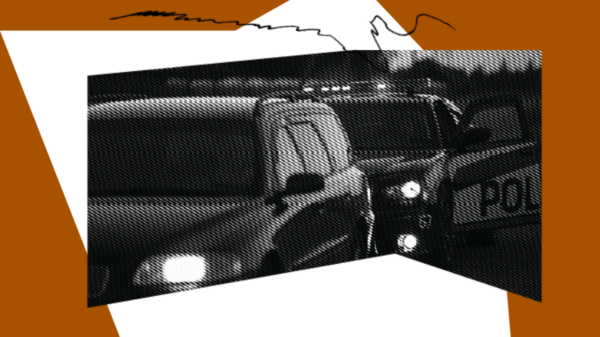
Have you ever been pulled over for an air freshener hanging from your rearview mirror? What about a cracked taillight? Stops like these are inconsequential to public safety but they happen because they are still listed as infractions in New Jersey’s traffic code. These stops, also known as non-safety traffic stops, often damage the relationship between the public and law enforcement, especially among communities of color who have historically experienced targeted over-policing.
Sometimes, non-safety violations are used to conduct pretextual stops in which an officer uses a minor traffic violation to pursue further investigation in hopes of discovering more serious offenses. Data has shown that Black and brown drivers are disproportionately stopped and searched on the roads more often than their white neighbors. Modernizing the traffic code will allow New Jersey to improve public safety and promote racial justice.
Instead of pulling people over for air fresheners and broken taillights, New Jersey should focus its resources on addressing dangerous driving, preventing accidents, and saving lives.
This type of traffic code reform is widespread and has already been successful across the country: it is clear that roads are safer, and enforcement is fairer, when law enforcement can focus on limiting dangerous driving. Our recent report, New Jersey’s Road to Safety and Racial Justice: Reducing Non-Safety Traffic Stops, showed that reducing non-safety traffic stops is a proven, simple, and popular way to improve public safety and promote racial justice.
As we continue to urge lawmakers to modernize New Jersey’s traffic code, we spoke with Niles Wilson, senior director of law enforcement initiatives at The Center for Policing Equity (CPE), about non-safety traffic stops, pretextual stops, and how other states have implemented similar reforms.
ACLU-NJ: What are non-safety traffic stops, and how do they relate to pretextual stops?
Niles Wilson: Non-safety traffic stops are motor vehicle stops for violations such as an expired registration, broken taillight, or certain equipment violations that don’t necessarily create an immediate threat to roadway safety. A pretextual stop occurs when an officer uses a legally valid, but relatively minor, traffic violation as the reason for the stop. Officers then use these legal stops to search for more serious crimes.
The distinction is important because not every non-safety stop is pretextual, and not every officer making a non-safety stop is looking for something else. As a retired police officer, I understand why officers use the tools the law allows. However, when the law allows for stops unrelated to safety, it can also create opportunities for pretextual enforcement.
CPE recently released a report and brief analyzing San Francisco’s pretext stop policy, in partnership with the San Francisco Public Defender’s office. The policy was created to curb racial bias in traffic stops by restricting officers from making stops for several minor reasons, such as a broken taillight. The report “Curbing Pretextual Stops: Early Evidence of Harm Reduction in San Francisco,” showed a significant reduction in harmful interactions between the police and drivers, without compromising public safety.
ACLU-NJ: How can New Jersey better use its resources to improve public safety?
Wilson: In FY2024, roughly $4.4 billion was spent on public safety in New Jersey. Improving the use of those resources begins with matching the appropriate public safety response to the public safety problem. Police are essential when there is a crime, violence, or an immediate threat to life or property, but not every call for service requires a law enforcement response.
My experience in Newark, and my work with police agencies through CPE, has reinforced the value of alternatives such as mental health professionals, crisis response teams, juvenile advocacy, addiction services, and homelessness outreach. Programs like New Jersey’s ARRIVE Together demonstrate the success of this approach. We should continue investing in these alternatives while allowing police departments to concentrate their resources on situations that genuinely require law enforcement expertise.
ACLU-NJ: Why should passing legislation to modernize New Jersey’s traffic code be a priority for our state?
Wilson: Police officers are responsible for enforcing the laws that are on the books. Relying on officer discretion to determine which laws make sense or asking officers to decide which laws should be enforced is not the answer. If we want officers to focus on behaviors that actually threaten public safety, the Legislature needs to make that expectation clear in the law.
Speeding, distracted driving, and impaired driving are significant contributors to serious crashes. For me, it’s common sense: police officers don’t write the law; they enforce it. If we want different enforcement priorities, we need to change the law.
ACLU-NJ: Some states have already passed similar legislation to improve their traffic codes. How has this helped their communities?
Wilson: So far, other jurisdictions have produced some encouraging results. For example, in Fayetteville, NC, researchers found that shifting traffic enforcement toward dangerous driving and away from equipment and investigatory stops resulted in fewer overall crashes, injury crashes, and fatalities. The change was also associated with reduced racial disparities in traffic enforcement.
In Connecticut, the Newington Police Department found that shifting resources from equipment violations to moving violations helped reduce lighting equipment stops and increased DUI enforcement.
However, we should be careful about how we characterize the data. There is no perfect apples-to-apples comparison across states. These examples don’t mean every jurisdiction will experience identical results. Yet these policy shifts demonstrate the value of directing limited police resources toward the violations that most directly impact roadway safety.